
Search
For cabinet manufacturers and RV converters, choosing between PVC vs ABS tambour doors involves much more than appearance. The two materials can look very similar once they are formed into interlocking tambour slats, but their actual performance can differ when a cabinet is exposed to heat, moisture, vibration, impact, and frequent opening and closing.
For furniture manufacturers, RV builders, and OEM buyers, choosing the right material at the beginning of a project can help reduce problems later with installation, operation, appearance, and long-term durability.

Both PVC and ABS are thermoplastics that can be extruded into interlocking tambour door slats and assembled with tracks to create complete custom tambour doors for different cabinet applications.
The main differences come down to the balance between cost, rigidity, impact resistance, heat performance, appearance, customization, and the environment where the finished door will operate.
PVC is generally the more economical option. It offers good moisture resistance, a lightweight structure, and flexible extrusion customization. This makes it a practical choice for indoor furniture, kitchen cabinets, appliance storage cabinets, and other applications where temperature exposure is relatively stable.
ABS is generally selected when a project requires higher impact resistance, better heat stability, consistent surface appearance, or stronger structural performance. It is commonly considered for RV interiors, campervan storage cabinets, mobile workspaces, premium furniture, and frequently used storage cabinets.
The following comparison is a practical guide rather than a universal product specification. Actual performance can vary depending on the resin grade, additives, profile design, thickness, extrusion process, and track system.
Comparison Factor | PVC Tambour Door Slats | ABS Tambour Door Slats |
Relative Cost | Lower | Higher |
Density | Typically higher | Typically lower |
Moisture Resistance | Excellent | Excellent |
Impact Resistance | Suitable for normal use | Higher |
Heat Performance | Better suited to temperature-controlled indoor environments | Better suited to higher-temperature conditions |
Surface Finish | Multiple colors and finishes available | Good color consistency when color is integrated into the material |
Customization | Flexible extrusion customization | Customized profiles and surface finishes available |
Typical Applications | Kitchen cabinets, furniture, appliance storage cabinets | RVs, campervans, premium and high-use cabinets |
For OEM buyers, the key point is simple:
There is no single material that is automatically better for every project. The right choice depends on what the tambour door will experience after installation.
Temperature is one of the most important factors to consider when selecting a tambour door material.
A vehicle parked under strong summer sunlight can become significantly hotter inside than the surrounding outdoor environment. Under these conditions, the tambour door system must deal not only with changes in the material itself, but also with thermal expansion and contraction, track clearance, vehicle vibration, and frequent opening and closing.
PVC can begin to lose some of its toughness at relatively lower temperatures. In demanding mobile applications, this may cause the tambour slats to expand and reduce the clearance between the slats and the track.
As a result, the door may experience increased operating resistance, sticking, or positional movement.
At lower temperatures, the opposite can happen. The material may contract and create a looser fit within the track.
ABS generally maintains better rigidity across a wider range of temperature changes, which is one reason it is often used for RV tambour doors and vehicle interior cabinet systems.
For applications exposed to vibration, frequent operation, and larger temperature fluctuations, ABS is generally a more suitable choice.
However, this does not mean that every RV cabinet must use ABS.
The right choice still depends on the specific project. If the operating environment is relatively controlled, the opening frequency is moderate, and the profile and track are properly designed, PVC can still be an economical and practical solution for certain mobile applications.
There is another factor that is easy to overlook:
The track design is also an important part of the thermal solution.
All plastic materials experience some degree of expansion and contraction as temperatures change. Appropriate installation clearance, slat dimensions, opening dimensions, and track construction can be just as important as the material itself.
Heat performance is not the only difference between PVC and ABS.
A kitchen cabinet door may be opened and closed many times every day. A cabinet inside an RV can experience continuous vibration while the vehicle is moving. A workshop or tool cabinet may be exposed to repeated impacts.
These different environments place different demands on the tambour door slats and their interlocking connections.
ABS is generally selected when higher impact resistance is important. Its toughness makes it suitable for vehicle interiors, commercial furniture, heavy-use storage cabinets, and other applications where the door may experience repeated knocks or impacts.
PVC remains a strong option for normal indoor applications, particularly when cost efficiency and moisture resistance are important.
For many kitchen and furniture projects, if the product will not face extreme temperatures or severe impacts, there may be little reason to pay for additional material performance that the application does not actually require.
Appearance is another consideration.
PVC tambour door systems can be supplied in different colors and surface finishes. ABS can provide good overall color consistency when the color is integrated throughout the material during the extrusion process.
For premium furniture projects where the cabinet front is an important design element, this color consistency can also become part of the purchasing decision.
For OEM projects, it is useful to evaluate the complete tambour door system rather than looking only at the slat material.
Consider factors such as:
Profile structure
Profile thickness
Track design
Connection method
Surface finish
Color
Installation method
All of these factors can influence the final product performance and user experience.
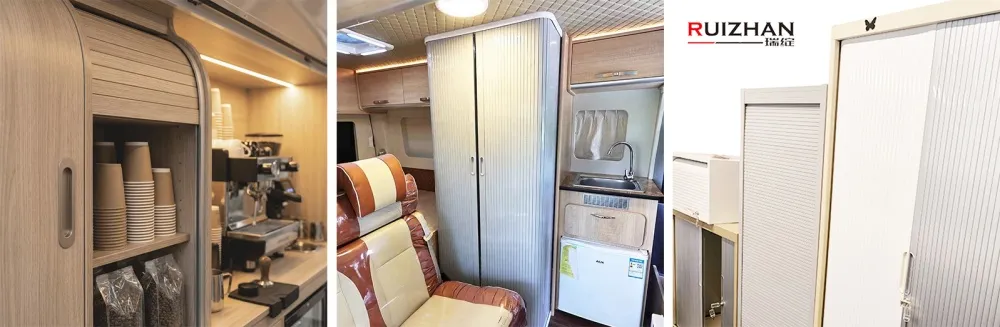
A more practical way to make the material decision is to start with the operating environment, rather than simply comparing material prices.
Application | Practical Choice | Main Reason |
Indoor kitchen cabinets | PVC | Good moisture resistance and cost efficiency |
Appliance storage cabinets | PVC / ABS | Depends on temperature and frequency of use |
Office furniture | PVC | Good balance of performance and cost |
RV cabinet systems | ABS | Better heat and impact performance |
Campervan projects | ABS | Better suited to vibration and temperature changes |
Premium indoor furniture | ABS | Good surface appearance and color consistency |
High-use storage cabinets | ABS | Higher impact resistance and durability |
This table should be treated as a starting point rather than a replacement for specific product specifications.
For large OEM projects, the supplier should review the actual cabinet opening dimensions, operating environment, expected usage frequency, and profile configuration before confirming the most suitable material.
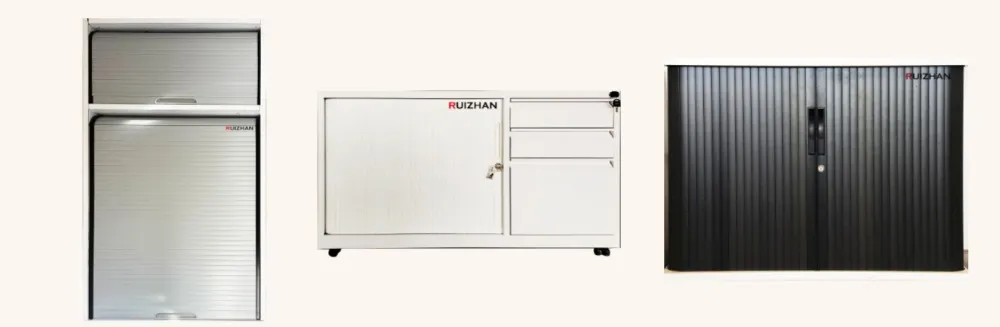
Material selection is only one part of tambour door design.
Before production, cabinet manufacturers should confirm:
Cabinet opening width and height
Door operating direction
Available space inside or above the cabinet
Tambour door slat dimensions
Expected frequency of use
Track installation method
Different tambour door configurations solve different space requirements.
Vertical straight-lift tambour doors are generally suitable for smaller cabinet openings and move between the open and closed positions.
Vertical roller tambour door systems allow the slats to roll into a drum and provide more flexible opening positions.
Horizontal tambour doors can slide toward one side or open from the centre toward both sides, making them suitable for certain wider cabinet openings.
Plastic tambour door systems also have practical size limitations.
However, the exact maximum opening depends on factors such as profile design, slat thickness, track construction, installation method, and actual operating conditions.
For particularly large cabinet openings, a reinforced structure or an aluminum tambour door system may be more appropriate.
For this reason, it is not recommended to choose the material first and then force the cabinet structure to accommodate the tambour door.
A more practical approach is to define the cabinet opening and operating environment first, then select the appropriate material and tambour door configuration.
For an OEM project, purchasing tambour door slats is only one part of the overall sourcing decision.
Consistent production and long-term supply capability are just as important as the material itself.
Before placing an order, OEM buyers should ask the supplier about:
PVC and ABS material options
Tambour door slat width and thickness
Available colors and surface finishes
Custom options
Track options
Maximum recommended opening size for the selected configuration
Dimensional consistency between production batches
Quality control during extrusion
Assembly and packaging methods
Required certifications and test documentation
OEM/ODM customization capabilities
Long-term production capacity
A manufacturer with its own plastic extrusion capability can also help customers evaluate whether a project should use PVC, ABS, or another structural solution based on the actual application.
For example, a furniture factory producing large volumes of indoor cabinets may place greater importance on cost, color matching, and production efficiency.
An RV manufacturer may place greater emphasis on heat performance, impact resistance, vibration resistance, and long-term operating stability.
A professional supplier should be able to discuss these trade-offs with the buyer rather than simply recommending the more expensive material.
One of the most common mistakes is choosing the material based only on unit price.
If the material is not suitable for the actual operating environment, a lower purchase price does not necessarily mean a lower total cost.
For example, a tambour door that tends to bind in high-temperature conditions, or one that becomes loose and noisy during vehicle operation, may create additional installation, warranty, and maintenance costs that were never included in the original quotation.
Another common mistake is ignoring the cabinet opening structure.
A tambour door solution suitable for a small cabinet may not be appropriate for a wider or taller opening.
Buyers should also avoid judging tambour door quality based only on product photos.
Two tambour doors that look similar may have significant differences in:
Profile structure
Material
Thickness
Track system
Connection method
Manufacturing precision
Therefore, the most useful comparison is not simply:“PVC or ABS?”
The better question is:“Which material, profile, and track structure are best suited to my specific cabinet?”
PVC can be used in certain mobile applications, but the actual operating environment should be carefully considered.
RV interiors can experience high temperatures and continuous vibration. Therefore, if a project requires higher heat stability and impact resistance, ABS is generally the more suitable choice.
No.
ABS offers advantages in more demanding environments, but PVC can be the better commercial choice for many indoor cabinet applications.
If the cabinet remains in a relatively controlled environment and does not face severe impacts or extreme temperature changes, PVC can provide a good balance of performance and cost.
For most indoor kitchen and furniture applications, PVC is a practical starting point because of its moisture resistance and cost efficiency.
If the project places greater emphasis on premium appearance, color consistency, or higher impact resistance, ABS can also be considered.
Plastic tambour doors generally require relatively little maintenance.
During normal use, keeping the slats and tracks clean is usually sufficient.
If the door starts to operate less smoothly, first check whether there is dust, debris, or an installation-clearance issue in the track.
In many cases, operating problems are not caused by the material itself. They may instead be related to the track, installation method, or foreign objects inside the system.
Customization capabilities depend on the manufacturer's extrusion and assembly capabilities.
Common customization options include:
Dimensions/Colors/Surface finishes/Profile structures/Track configurations/Packaging methods
OEM buyers should confirm the available customization options and actual production tolerances with the supplier before placing an order.
The PVC vs ABS tambour door decision becomes much easier when the project is evaluated from the operating environment outward.
For indoor furniture, kitchen cabinets, and appliance storage cabinets, PVC often provides a good balance of moisture resistance, customization flexibility, and cost.
For RVs, campervans, high-use storage cabinets, and applications exposed to greater temperature fluctuations or impact, ABS is generally a more suitable option.
The important point is not to choose the most expensive material.
It is to choose the material and tambour door configuration that match the actual working environment.
For OEM buyers, it is useful to provide the supplier with the following information in advance:
Cabinet opening dimensions
Installation environment
Expected frequency of use
Target color and surface finish
Estimated order quantity
A manufacturer with experience in plastic extrusion can use these requirements to help determine the appropriate tambour door material and structural configuration.
Making the right material decision at the beginning of a project can help achieve easier installation, smoother operation, greater long-term stability, and fewer after-sales issues.
After selecting the right material, accurate measurement is the next step for a successful project. Learn more about how to measure for a custom tambour door before placing an order.