
Search
Even if the surface of a furniture panel is finished very exquisitely, the overall quality of the final product can still be affected if the edge banding is not properly applied. The edges of cabinet doors, wardrobes, office desks, and other panel furniture are often exposed to impacts, friction, and repeated contact during use, while the cut edges of panels also directly expose the internal substrate. Edge banding not only improves the visual appearance of these areas but also provides necessary protection for the panel edges.
For furniture manufacturers and panel processing companies, selecting edge banding is not simply a matter of finding a material with a “similar color.” Whether the edge banding material is suitable for the panel substrate, whether the thickness and width match, whether the surface texture and gloss are coordinated, and whether the adhesive is compatible with the edge banding equipment will all directly affect the final edge banding quality. Among them, PVC (polyvinyl chloride) edge banding is widely used in furniture, cabinets, and other panel products thanks to its good flexibility, rich choices of colors and surface finishes, and mature processing adaptability. However, even when PVC edge banding is used, it still needs to be properly selected according to specific application conditions.
A more reliable approach is to first clarify the furniture product’s requirements for edge appearance, durability, and processing performance, and then determine the edge banding material and specifications accordingly. The following factors are the most important aspects to focus on during the actual selection process.
Common substrates used in furniture manufacturing include medium-density fiberboard (MDF), particleboard, and other engineered wood panels. After panels are sawn or processed, the internal substrate is exposed at the edges. If edge banding is not applied, it will not only affect the overall appearance of the furniture but also make the edges more vulnerable to daily impacts, friction, and environmental moisture.
Edge banding covers the exposed edges of panels, creating a more complete transition between the panel surface and the edge while improving the overall visual integrity of the furniture. For products such as cabinet doors, wardrobe door panels, office desks, and bookshelves, edge banding is often one of the important details used to judge the refinement of the product.
This is especially true in designs with large surfaces and long edges, where the color, gloss, and joint effect of the edge banding become more noticeable. If there is an obvious color difference between the edge banding and the panel, or if uneven edges appear after trimming, the overall effect of the finished furniture may still be affected even if the panel surface itself is of high quality. Therefore, edge banding is best selected at the same time as the panel and furniture design are finalized.

Common edge banding materials in the furniture industry mainly include PVC (polyvinyl chloride), ABS (acrylonitrile butadiene styrene), and acrylic (PMMA). These materials each have different strengths in terms of flexibility, impact resistance, dimensional stability, and decorative effects. Therefore, the actual choice should be based on the furniture’s usage environment and processing technology, rather than simply comparing material names.
| Material | Main Characteristics | Typical Application Considerations |
|---|---|---|
| PVC (polyvinyl chloride) | Good flexibility, with rich choices of colors and surface finishes | Suitable for furniture, cabinets, wardrobes, shelving, and various types of panel furniture |
| ABS (acrylonitrile butadiene styrene) | Higher toughness and good dimensional stability | Suitable for applications with higher requirements for impact resistance and long-term durability |
| Acrylic (PMMA) | Strong decorative effect and capable of presenting visual effects such as high gloss | Suitable for modern, high-end furniture designs and furniture designs that emphasize appearance |
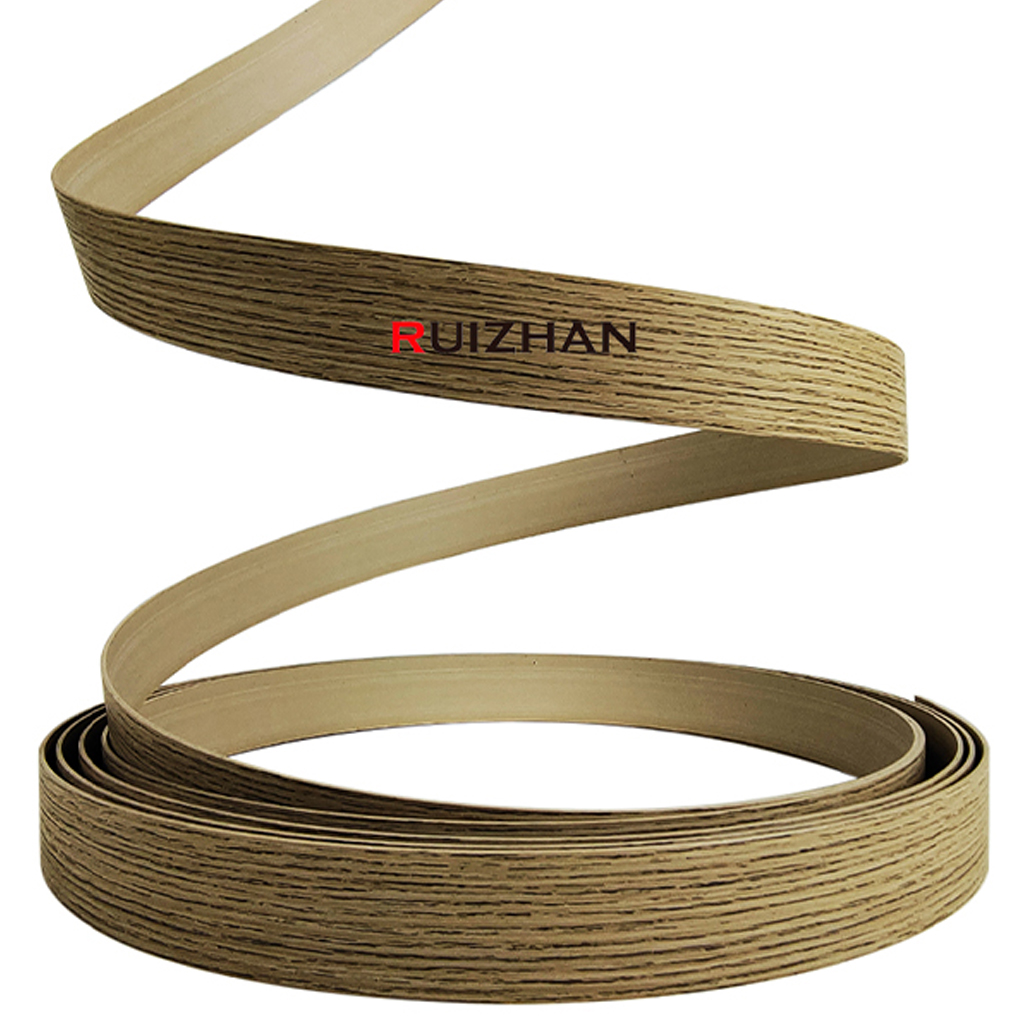
PVC edge banding has become one of the commonly used edge banding materials in the furniture industry because it offers a good balance of processing performance, durability, and decorative effect. Whether for solid-color panels, woodgrain panels, or different surface effects such as matte and glossy finishes, corresponding PVC edge banding solutions can be found, allowing it to adapt to a wide range of furniture designs.
If furniture is likely to be impacted during transportation, installation, or daily use, ABS edge banding can be considered as an option. Its toughness and dimensional stability offer certain advantages in such applications. Acrylic edge banding is more often used for products with higher visual requirements, such as high-gloss furniture or modern decorative panels.
Therefore, there is no “best” edge banding material suitable for all projects. Residential wardrobes, commercial office furniture, and retail display cabinets may use similar panels, but they may still require different edge banding solutions due to differences in usage frequency, design style, and durability requirements.
The thickness of edge banding is related not only to visual proportion but also to subsequent processing. Thinner edge banding usually creates a cleaner and more understated edge effect, while thicker edge banding can present a more pronounced edge profile and provide more processing allowance during trimming.
The specific thickness cannot be determined independently of the panel and equipment. Panel thickness, edge structure, furniture design, and the processing capability of the edge banding equipment should all be taken into consideration. For furniture with higher appearance requirements, the thickness of the edge banding also needs to remain coordinated with the overall design proportions.
The width of edge banding is equally important. The basic requirement is that it should fully cover the exposed edge of the panel while leaving a reasonable trimming allowance. If the width is insufficient, the substrate may be exposed after trimming; if the width is obviously too large, it will increase trimming volume and material waste without necessarily producing a better finished result.
In addition, the geometry of the panel edge should also be considered. Straight edges are usually easier to process, while edges with rounded corners or special profiles require the edge banding material to have good conformability. If the material cannot smoothly follow the edge curve, problems such as edge lifting, wrinkling, or poor local adhesion may occur.
Therefore, when determining the width and thickness of PVC edge banding, it is best to verify them together with the actual panel and processing method. Confirming whether the dimensions are suitable through samples is usually more reliable than selecting specifications based solely on a product catalog.
Color matching for edge banding may seem simple, but in actual production it often becomes a factor that affects the consistency of finished products. Different light sources can change the visual appearance of materials, and the colors displayed on a computer or mobile phone screen cannot fully represent the actual color. Therefore, determining edge banding solely based on electronic images or color names often involves a certain degree of error.
For solid-color furniture, the edge banding should be directly compared with the actual decorative panel. In addition to the basic color tone, surface gloss also needs attention. Even if the colors of two materials are very close, if one has a matte surface and the other has a higher gloss level, obvious visual differences may still appear under actual lighting.
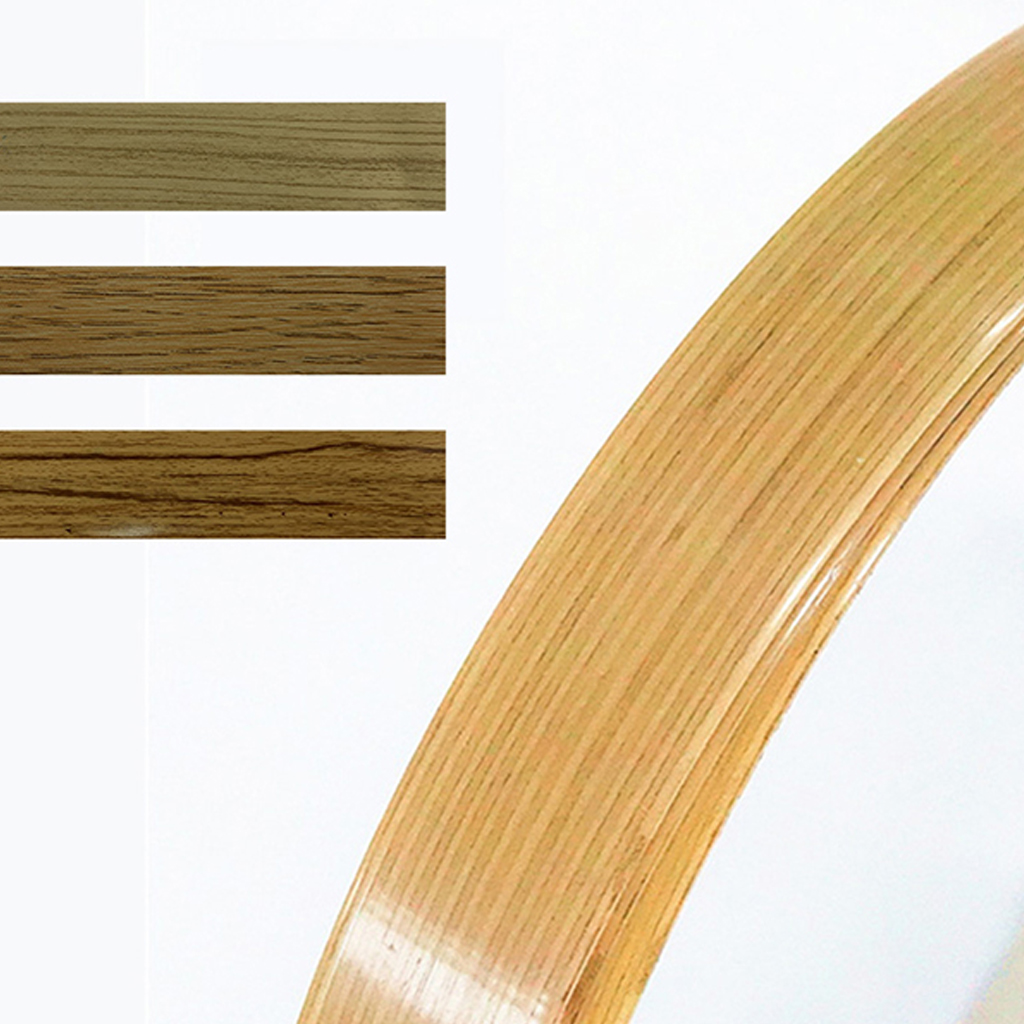
Woodgrain panel matching has even higher requirements. In addition to the base color, it is also necessary to consider woodgrain direction, texture density, pattern continuity, and surface feel. The ideal edge banding effect should make the edge look integrated with the panel, rather than showing an obvious “post-applied” decorative effect.
When selecting PVC edge banding products, color, specifications, and surface finish can be compared together instead of focusing on a single parameter. For projects with high requirements for appearance consistency, providing actual panel samples for color confirmation is usually more accurate than providing only photos.
Edge banding quality does not depend entirely on the edge banding itself. The condition of the panel edge, the type of adhesive, and the operating parameters of the edge banding equipment can also significantly affect the final result.
Before edge banding is applied, the panel edges should be kept clean and dry, and dust, debris, or other contaminants should be avoided as much as possible. If the substrate surface is not properly prepared, the adhesive may fail to form a stable bond, which may later lead to edge lifting or detachment.
The adhesive also needs to maintain good compatibility with the edge banding material, panel substrate, and equipment. Equipment temperature and feed speed should be adjusted according to the specific adhesive system and equipment condition, rather than simply copying the parameters of another production line. If the parameters are unsuitable, problems such as obvious glue lines, weak bonding, edge banding lifting, or uneven trimming may occur.
Therefore, small-batch sampling before formal mass production is very valuable. Applying PVC edge banding directly to the actual panel allows a more intuitive evaluation of whether the material and process are compatible. After the sample is completed, attention should be paid to bonding strength, trimming quality, surface defects, color consistency, and the overall visual effect.
If a large amount of manual finishing is required to improve problems such as glue lines, burrs, or uneven trimming, the material specifications and processing parameters should be checked first instead of proceeding directly to mass production.
A clear product specification can significantly improve the accuracy of supplier selection and quotation. Simply stating “white PVC edge banding is needed” is usually not enough to determine the truly suitable product, because dimensions, surface finishes, and processing conditions may all vary.
First, the panel material and thickness should be clarified, and then the required edge banding width, thickness, color, surface effect, and edge profile should be determined. If a certain adhesive or edge banding equipment has already been selected for the production line, it is also recommended to provide this information, as it helps assess the compatibility between the product and the existing process.
For woodgrain furniture, providing actual decorative panel samples can usually greatly reduce repeated communication during the color matching process. The supplier can use the physical sample directly as a reference, allowing more accurate judgment of color tone, texture, and surface effect.
If the project requires long-term repeated production, consistency between different batches should also be considered. Good performance in one sample does not mean that all subsequent batches can maintain exactly the same color, dimensions, and surface quality. Therefore, for long-term furniture projects, stable product quality and supply capability are equally important.
If the project involves special colors, dimensions, surface effects, or specific processing conditions, you can directly communicate the specific project requirements with Ruizhan. Providing panel information, target specifications, and actual processing conditions together can make early technical communication more efficient and also help reduce the possibility of later specification changes.
A truly high-quality edge banding effect often does not deliberately draw attention, because it should naturally integrate into the overall furniture design. To achieve this, the edge banding material, dimensions, surface finish, and processing technology need to be well matched.
PVC (polyvinyl chloride) edge banding is suitable for many furniture and panel applications thanks to its good flexibility, rich decorative choices, and mature processing adaptability. If the project places greater emphasis on impact resistance and dimensional stability, ABS (acrylonitrile butadiene styrene) edge banding can be considered; if the product emphasizes high gloss and decorative effects, acrylic (PMMA) edge banding solutions can be further evaluated.
Compared with choosing solely based on price or color, a more reliable method is to verify the product together with the actual panel and production process. By confirming dimensions, color matching, and processing effects through samples in advance, rework and adjustments after mass production can be reduced, allowing the edge banding to maintain a stable and coordinated finished effect from the first batch of products to subsequent orders.
PVC (polyvinyl chloride) edge banding is mainly used to cover the exposed edges of furniture panels, improving appearance while providing a certain level of daily protection for the substrate.
Yes. PVC edge banding is widely used in panel furniture such as cabinets and wardrobes, but the specific specifications need to match the panel, adhesive, and edge banding equipment.
The panel thickness, edge structure, design effect, usage environment, and processing capability of the edge banding equipment should all be considered. For projects with higher requirements, confirmation through actual samples is recommended.
PVC offers good flexibility and a wide range of colors and surface effects; ABS places more emphasis on toughness and dimensional stability. The specific choice depends on the actual application requirements of the furniture product.
It is recommended to use the actual decorative panel directly as the color reference. For projects with high requirements for appearance consistency, it is best to confirm with physical samples rather than relying entirely on electronic images.
It is recommended to provide the panel material and thickness, edge banding width and thickness, color or texture, surface finish, and edge profile. If the adhesive and edge banding equipment have already been determined, relevant information should also be provided for compatibility evaluation.