
Search
There is no fixed number of years. A cabinet door opened a few times a day has a very different workload from a commercial cabinet opened dozens of times a day.
For plastic tambour doors, service life depends on the slat material, profile, track installation, opening frequency, temperature, dust, and other conditions.
Our internal fold testing: plastic tambour door slats have completed multiple folding cycles under controlled conditions. This result demonstrates repeated-use performance, but it should not be treated as a guaranteed lifespan.
Our internal test recorded folding cycles for plastic tambour door slats during repeated opening and closing.
A cycle test is useful because it gives buyers a measurable reference when comparing products. However, the test result does not mean that every door will last the same number of cycles in actual use.
For example, a cabinet opened five times a day will accumulate operating cycles much more slowly than a commercial cabinet opened 30 times a day.
The actual service life also depends on the track system, installation, environment, and slat specification.
The plastic formulation affects resistance to ageing and environmental exposure. Applications with strong sunlight or high temperatures may require a suitable UV-stabilised specification.
The slat should match the opening size and application. Using an unsuitable profile for a large opening can increase flexing during operation.
The tracks need to run parallel. Misalignment increases friction and can make the curtain difficult to move. It can also put additional stress on the connectors.
Daily operating frequency matters, but so do heat, dust, humidity, and dirt inside the track.
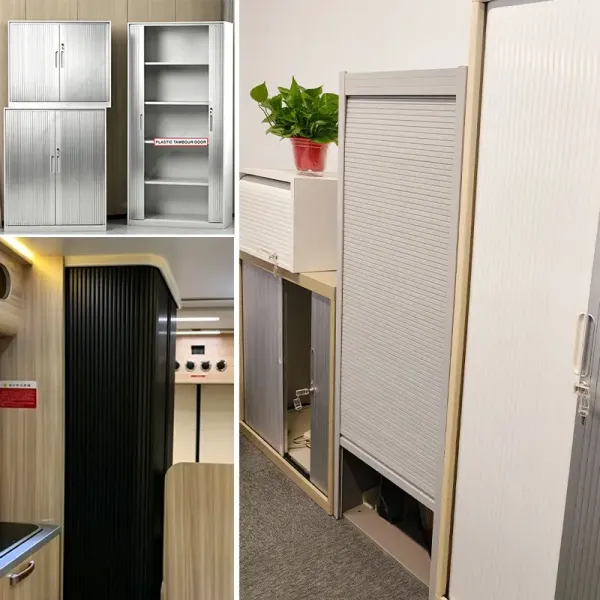
An RV, kitchen cabinet, office cabinet, and commercial counter do not have the same operating conditions.
When a tambour door becomes difficult to slide, the plastic slats are not always the first problem.
Check these areas first:
Track: Dust, dirt, or misalignment can increase resistance.
Connectors: Damaged or broken connectors can affect the movement of the curtain.
Clearance: Insufficient clearance can cause problems when the material expands with temperature changes.
Installation: A poorly aligned track can make a correctly manufactured door operate poorly.
This is why checking the complete door system is important when evaluating durability.
Good installation and simple maintenance can reduce unnecessary wear.
During installation:
· Keep the tracks parallel.
· Leave suitable clearance for thermal movement.
· Keep screws flush with the track.
· Use the correct slat profile for the opening.
· Check the door movement before finishing the installation.
During use:
· Keep the track free of dust and grit.
· Clean it regularly with a dry cloth or soft brush.
· Use a small amount of dry silicone or lubricant if required.
· Avoid oil or grease because they can collect dust.
· Do not force the door when it is already sticking.
If a door suddenly becomes hard to slide, check the track and alignment before assuming that the slats need to be replaced.
The standard warranty is 1 year, although the exact terms can vary by product line.
Warranty | Standard terms |
Period | 1 year |
Covers | Material defects and workmanship faults |
Examples | Slat defects, connector failures, extrusion or assembly problems from production |
Not covered | Improper installation, misuse, forced operation, normal cosmetic wear |
Outdoor use | Requires a suitable UV-stabilised specification |
If a problem occurs during the warranty period, customers can provide photos, a short video, and the order record. This helps the product team determine whether the problem is related to manufacturing, installation, or use.
Standard plastic tambour doors are generally intended for indoor applications.
Outdoor installation adds UV exposure, temperature changes, moisture, and other environmental factors. These conditions can shorten service life and may fall outside standard warranty coverage.
If outdoor use is required, the plastic specification should be confirmed before production. A UV-stabilised compound and suitable protection from direct sunlight may be necessary.
A sticking door does not always need to be replaced. First check the track, alignment, clearance, and connectors.
Replacement becomes more appropriate when:
· The slats are cracked.
· Connectors are broken.
· The curtain has permanent deformation.
· The door repeatedly comes off the track after alignment.
· Damaged components cannot be corrected or replaced.
For B2B buyers, identifying the cause of the problem before replacing the complete door can help reduce unnecessary replacement costs.
There is no fixed lifespan in years. while actual service life depends on installation, operating frequency, material specification, and environment.
They can be suitable for repeated cabinet use when the slat profile, track, and installation are correctly matched to the application. Internal testing of our plastic tambour door slats exceeded 10,000 folding cycles under controlled conditions.
Routine cleaning of the track can help maintain smooth movement. Dust and grit should be removed regularly, and the door should not be forced when it becomes difficult to operate.
The standard warranty is one year, covering material defects and workmanship faults. Exact terms may vary by product line and application.
This is the first one.